|
Today for the first time I came across the "Chan" photograph of an alleged dinosaur survival, and here offer some skeptical thoughts as to the validity of the photograph. The image of the "Chan" cryptid is one of those photographs which for a split second seem totally amazing, before producing a vague impression that something is "not quite right" with the image, the picture thus intuitively rejected as "fake looking". The mind forms this impression almost instantaneously. I suggest some of the reasons producing this impression are the lack of convincing water displacement and shadowing by the supposed creature, (as a physical object).
Such a massive animal should have a marked effect on the water surface around it. The blurring and general attitude of the creature suggest it is moving away from the camera, (if the animal was content to stand still and give the photographer plenty of time, why are there not additional photographs, better composed and from subtly different angles?). However, there is no trace of a "bow wave" made at the front of the animal as it ploughs through the water. The lack of turbidity, (white water or stirred up sediments) make this a very unconvincing picture of a massive animal moving through water.
To explain these points we would have to assume the animal was standing perfectly still, a bit like a lizard basking in the sun. Note the objections in the previous paragraph to producing such a limited photograph from such a convenient subject. In addition, even a large animal standing still would have some impact on the water surface. We clearly see wind-induced wavelets on the lake surface, but these run in the same direction both behind and in front of the cryptid. In reality, waves will bend and curve in response to an "island" obstruction such as that of a large animal standing in water. No such surface response is evident in the picture. In some places, (the neck in particular), there are dim lines that seem to represent the continuation of the wavelets in the background on either side, as if the animal is in fact translucent!
The shadowing in the photograph is another point the eye picks up on as being somehow unconvincing. What appears to be the shadow of the neck reaches outward across the water, (ie, towards the camera), quite strikingly. In contrast, the shadow of the back / hump seems hardly to reach out at all, (the line of "whiteness" along the base of the photograph represents water rather than shadow, so it isn't simply a case of the back's shadow being truncated by the photograph edge). In short, two parts of the same object are casting shadows as if the sun was at two different angles simultaneously.
My conclusion would be that the photograph has been retouched to include an "object" that was not physically there when the photograph was taken. The flat appearance of the object and lack of gradations of light falling across it provide additional support for this view. It is strange that the image has been cropped so as to minimize foreground in front of the creature. I suspect this has been done to remove an expanse of water obviously not being affected by the massive creature supposedly adjacent to it.
I found the suggestion of Miguel Churruca that the object was in fact the head and trunk of an elephant ingenious and intriguing, but I think that an elephant, (or a dinosaur), that was physically there would have left more impressions on the water surface. Pictures of elephants generally show the head and neck to be angular in silhouette rather than the continuous curve in the photograph, and one would expect the detail of the ear in particular to be more prominent and crisp, (unless it has been clumsily removed by retouching).
The experimental fake produced by Aaron Justice has very much the same "feel" to it as the original photograph in terms of the lack of water displacement and shadowing. I know nothing about the history of the photograph, but I doubt that it was produced digitally, since using digital software it would have been extremely easy to darken the silhouette so as to get rid of the unconvincing and smudgy detail on the body, which as Aaron has noted, does not appear to correspond with the expected position of the limbs. More than anything else, this "detail" seems to resemble a continuation of the wavelets on the lake behind, as if the creature was translucent. My guess is that the image was physically retouched with ink many years ago, and that either through age or incompetence, the original background is beginning to show through.
| The Black Panther: Fact or Folklore |
| By Robert Prevo |
|
Few things in nature can inspire such awe as the shadowy movements of a predatory cat moving through the dark forests. However, some legendary cats seem to be nothing more than mere shadows. Shadows that seem to move in and out of our reality at whim, only letting us glimpse them for a second and then disappearing as though they were never really there.
The legendary "Black Panther", as it has become known, is the epitome of just such a "shadow". For hundreds of years this mystery cat has been moving in and out of the shadows of North America and has evaded true scientific notice all the while. Or has it? Is there really anything to the mysterious "Black Panther", or is it just a matter of some kind of mass hysteria that's been passed down from generation to generation?
As any member of the zoological community will tell you, North America only has three types of native cats. Our native felids are the Cougar (Felis Concolor), Bobcat (Felis Rufus) and Lynx (Felis Lynx) (the latter of the two actually being very closely related). However, lately the zoological community is amazed to find that they might not be as sure as they once thought. Recent studies in Arizona have recovered pictures of Jaguars crossing through the countryside at night. As well, Texas seems to be on the verge of accepting that they may have a new invader from the south, in the form of a South American cat known as the Jaguarundi. Are we on the verge of discovery, or are we just waking up to see that some things aren't as "cut and dry" as we had previously  believed? believed?
The legendary "Black Panther" may be many things, but one thing it isn't is new to the scene. It's widely debated that the history of sightings may go back as far as the colonization of the New World. However, most evidence points to sightings only being as distant as the end of World War Two. One reason for the debate is the term "Panther". This one word has been used to describe many different species of felids over the centuries.
A true "Black Panther" is actually a melanistic form of the Leopard (Panthera Pardus), which is found in Africa and throughout most of Asia, parts Europe and the Middle East. To confuse matters more, this term has also been used to describe the melanistic form of the Jaguar (Panthera Onca), which is found most commonly throughout South and Central America. Now to add yet another twist to this term, it has also been used as a regional name for the Cougar (Felis Concolor), which was once common throughout all of North, Central and South America. As if that isn't bad enough, the term "Black Panther" has been used by the "Average Joe" to describe any unidentified black cat that he/she has had the fortune of crossing paths with.
Melanism
Melanism, simply put, is an abnormal amount of melanin in the upper layers of the skin and hair. This occurs as a genetic mutation, for the most part, but in some cases can be the "norm" for the species or sub-species. In felids, this is often mistaken to result in a completely black individual. The truth of the matter is that not even the darkest colorations in felids are ever truly black. Instead, under close examination, one will find that the coat is actually a very dark brown.
N.A.B.P.
N.A.B.P. is a common acronym used by researchers to separate the "North American Black Panther" from the confusion incurred when simply referring to this mystery cat as a "Black Panther". However, the question still remains "What is the N.A.B.P.?"
The N.A.B.P. seems to be almost an "interspeciel chimera" of sorts. Most all reports indicate a mixture of traits found only in separate well-documented felids. For instance, the N.A.B.P. is often witnessed to be approximately 40-48inches in length, about 20-24inches in height, with a very long tail (usually described as at least the length of the body, if not longer), a head built more like that of a bulldog and red glowing eyes. Not to mention, that this animal is almost always described as completely black.
The described length of this animal would mark it as a mid-sized to large felid however, the reported height seems to be more in character with that of a smaller felid (such as the Bobcat or Lynx). The above mentioned tail-length in proportion to body-length is usually only described in encounters with the Snow Leopard (Panthera Unica). While, the "bulldog-like" head is usually a description one encounters when talking about a Jaguar (Panthera Onca). However, "red glowing eyes" can be a common natural occurrence, which takes place when incoming light is reflected off the retinas of certain animals.
Theories
So then, what are we dealing with here? There are many popular theories floating around out there, both on the Internet and in many Cryptozoology books.
One of the most common of these theories is that of a melanistic Cougar. With the increased sightings of Cougars on the rise, one has to wonder if this may in fact be a possible answer. However, the fact remains that there has never been any officially confirmed report of a melanistic Cougar, either in the wild or in captivity.
The next most common of these theories is the one of Jaguars or leopards which have been inadvertently released into the wilds of North America. Some claim that escaped zoo or circus animals may be to blame for these sightings as well. While this theory has some of the most validity, it also has one major drawback. There have been no sightings of the more commonly colored Jaguars and Leopards in North America. With the exception of the Jaguar which was photographed in Arizona. However, this sighting has been answered by the close proximity to the animals known home range.
Another theory is that of a possible subspecies of Jaguarundi, which has secretly been in place in North America and has yet gone undetected. While many eyewitnesses do confirm the likeness of the N.A.B.P. to that of the Jaguarundi (Felis Yagourundi), there is dispute over the size of the head. While the head of the Jaguarundi is small and more built for taking smaller prey items, the head of the N.A.B.P. (as reported) seems to be larger and built much heavier for taking larger prey items.
Yet another theory which has surfaced on this issue is that of a prehistoric survivor. Loren Coleman and Mark Hall theorize that a relict population of the Cave Lion (Panthera Atrox), which once inhabited North America, has survived to present day. They also believe that the females of this species may be sexually dimorphic, which causes them to be black while the males are the more common tawny color. There are two problems, which occur with this theory. The first is that this theory is built on the theory of living prehistoric animals. The second is that of sexual dimorphism in the species. Why would only females be black? If sexual dimorphism were to occur in the species it is much more likely to appear in the male than the female.
The last theory is the one of an as-yet-unknown felid being native to North America. Could there be such an animal lurking in our dark forests? Or, are we just kidding ourselves into believing in a mystery that has no real answer?
The fact remains that every year science makes new discoveries. Maybe the discovery of the "North American Black Panther" is just right around the bend? |
|
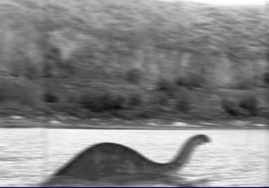 One thing that seems suspicious is the neck. It seems too short for the type of dinosaur that it is. When I turned the brightness up on the photo, it reduced a lot of the blur. The neck looked a little longer than I first thought, the blur of the camera moving gives the impression of a thicker neck. Besides, many species of sauropod have short necks, not all of them were like the immense brachiosaurs of Jurassic Park or the long necked mamenchisaurs of The Lost World: Jurassic Park. Plateosaurs, called a prosauropod because it appears primitive to other species, have short necks but long tails, even though their size altogether was about 30 feet long. The body of the creature, which I will nickname, "Chanosaur", seems to have an apatosaurid like shape; the body rises high out of the water. This is not a characteristic of a brachiosaurid or a diplodocid because both bodies did not have a high arch, but a body parallel from the shoulders to the hind legs, or with a downward slope in the case of some brachiosaurids. The arch is most likely caused by a tall hind leg and a short fore leg. As some people have pointed out about mokele-mbembe, Chanosaur is seemingly dragging its tail rather than keeping it lifted in the air as recent studies suggest about most dinosaurs. Although that may be true, not all dinosaurs needed to keep their tails off the ground, most likely just the larger ones. Most large sauropods have necks at least 20 feet long; the giant mamenchisaur had a neck 32 feet long, about half the length of its body. It most likely had its tail lifted in the air as a counterbalance to the neck, which also was probably held at a 30-degree angle. Imagine holding a 32-foot long pole in front of you. It would be much easier to hold it at around a 45-degree angle rather than right out in front of you.